
Here’s an update on a tree I’ve been working on for a little while now. This native huckleberry, Vaccinium elliottii, has been of interest to me due to the fact that I push working on southeast native plants for bonsai so often. I did a full article on the treatment and care for this species and you can click the link here to read the full study I wrote up.
Here’s the tree as of June 2024

I’ve been allowing this tree to grow freely this spring into early summer. I choose to do this because I was having an issue with the tree that I wasn’t quite getting a grasp on.
I was watering and fertilizing it like I normally would when it comes to bonsai that I have in refinement mode. I typically try to water once a day, twice in the summer if things get really spicy here, and fertilize it with only organic plant foods. I’ve been liking the Green Growth organic fertilizer that Stone Lantern offers as it breaks down easily into the soil and creates a little bit of “crust” on the top. This crust helps facilitate a localized ecosystem in the soil for all the magical things to happen that move the cation exchange of nutrients along.
The breakdown of organics is more ideal for bonsai that are in refinement, I’m referencing the process of increasing the amount of ramification and minimalizing the leaves. Believe it or not, this slowed process even slows down the tree’s metabolism so that the water uptake slows slightly as well. With a good balance on an older bonsai like this you won’t find yourself watering nearly as much. Although, it is a very marginable amount and you probably will feel like your watering just as much as before. It’s the little things that count.
Back to the issue I was having with this particular tree and to be honest the issue I was having with this species. I knew I was dialing in a lot of things that trees love which, like mentioned above, which is fertilizer, the amount of sunlight pre-day, watering after near dry down, and trimming only when the tree has fully hardened off. They don’t love the being trimmed part but it is the best way to get strong twigging to support even smaller foliage. Despite all the things I was providing the tree it was not growing well. When I say not growing well, I mean not growing at all. A few shoots emerged for new leaves in the early spring but nothing really extended out and got crazy like I expected. Then the tree kind of sat in a dormant feeling state for two months.
The issue I was having is that I didn’t adjust the PH in my water so that the tree could start the process of breaking down the nutrients it needed. I measured my water PH at my home at 7.8, much too high for an acid loving plant that the huckleberry is. Huckleberries are simply wild blueberries in my range. The answer to my problem was very clear, just lower the PH to 6.0 and the tree should thrive.
I used a basic soil acidifier to get the job done. It’s a granule acidifier similar to a slow release synthetic fertilizer work. After what only seemed like a week after application of the acidifier, the tree seemed to jump into action to how it appears in the photo above.

Now that the issues seem to have resolved here is the tree after a nice trim back. If you refer to the other article where I trimmed it back that time you can see that the crown was having a hard time filling in. Also, there was a lack of weight in foliage and branches on the right side of the tree. The huckleberry is beginning to settle into the container cultivated life for the most part. Another thing I’ve been observing is the way the nebari has been developing. The thickening of certain roots has lead to me considering on changing the front to what is pictured above.
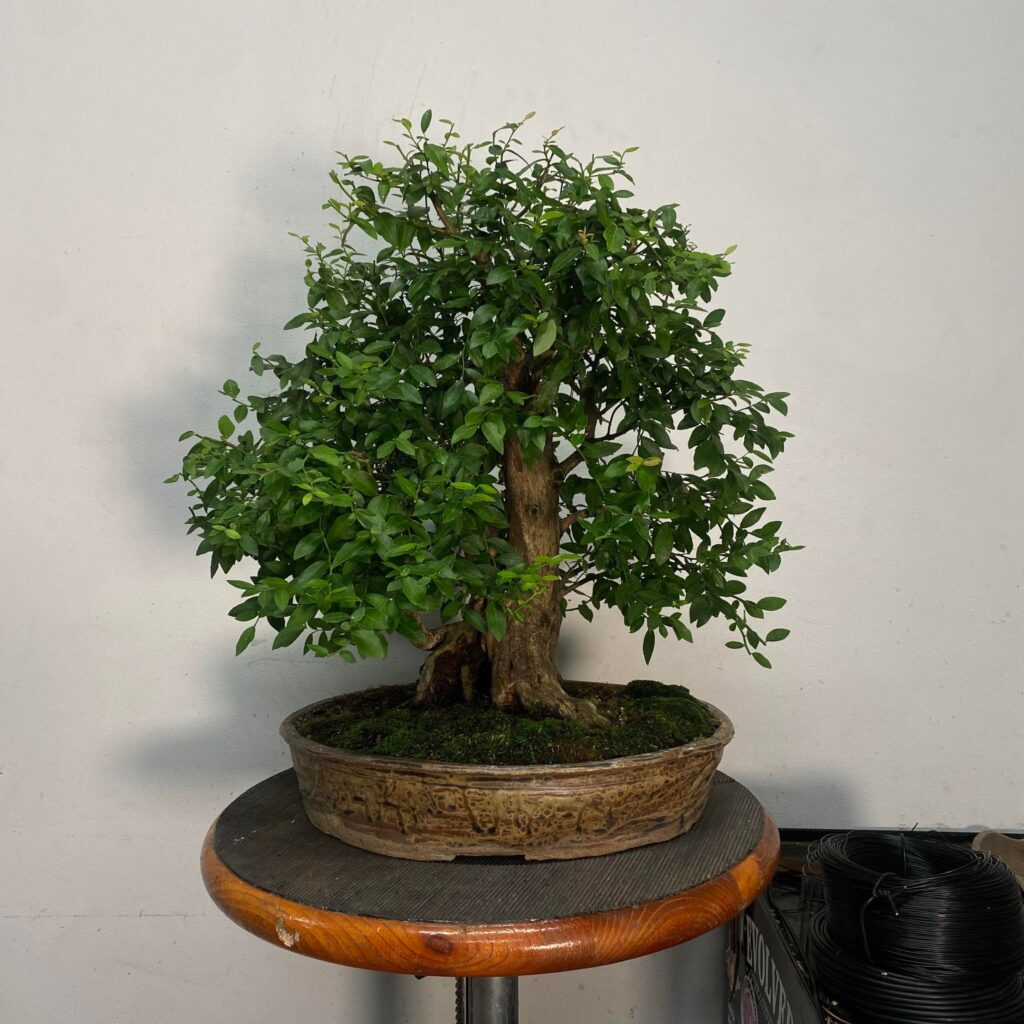
Here’s the current front I originally chose for this tree. Not as interesting anymore and the movement is being heavily influenced by the silhouette. Luckily, this is will be an easy change in the next spring season.
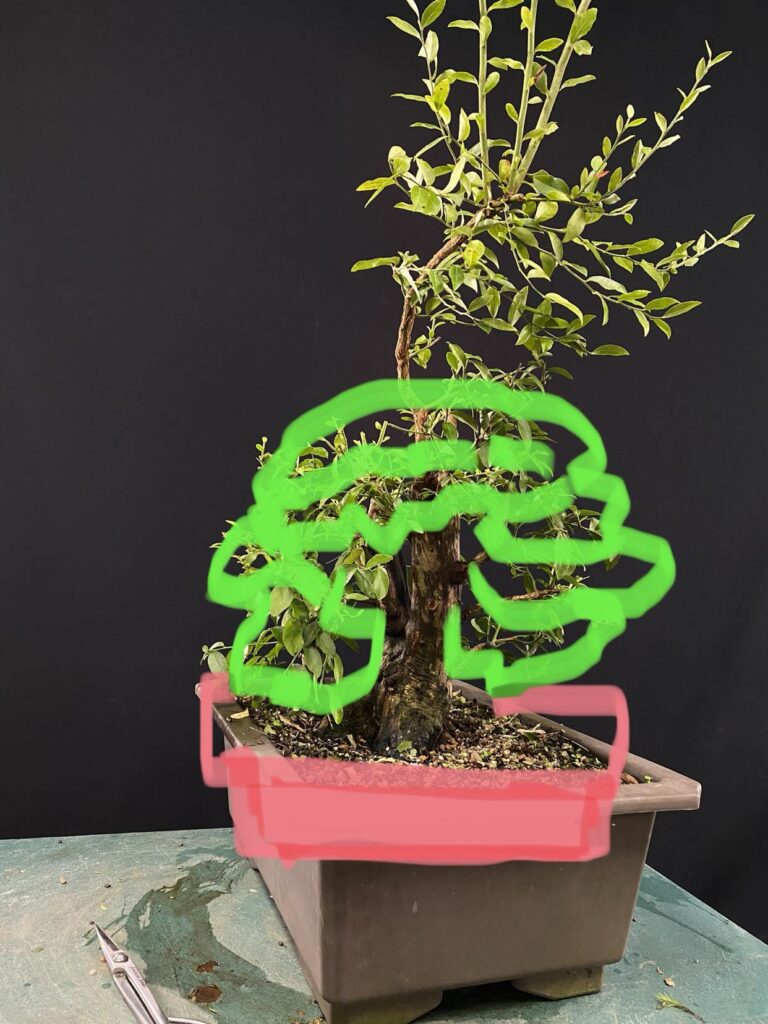
The picture above is from 2022 were I drew a crude drawing over the top of the tree to see if I could predict the future front and silhouette. If you refer back to the most recent picture of the tree you can see that this is very close to the front I am favoring now. The root on the backside of the right-side of the tree is just now starting to thicken to make this a desirable view for this tree.
Anyways, I thought this would be a nice little update on a tree I’ve had a lot of fun developing and to say I’ve created a bonsai out of an otherwise “trash” plant. A lot of shrubs and trees are overlooked for bonsai here in Louisiana due to the fact that not a lot of research has been done into making them happy in a container. It does take a lot of trial and error to get to this point of course. I think it is definitely well worth the struggle for a blood red fall color and a bare branched display of white bell flowers on this little beauty!
-Evan